MISE.005 · A FLEET · UNBUILT
Mothership
a rollout with a nervous system.
Each store senses its own day. What it finds travels to every other store, and to the next one before it opens.
The problem
What works for three stores often breaks at thirty, if not sooner. A rollout copies the first store from drawings, and what made it special lives in a few heads, so the details go one opening at a time and nobody keeps what each store found.
- What it is
- Our proposal for a chain of stores that shares what each one finds. Every store gets an AI of its own: an open source engine on a small box in the back room. It learns that store alone. Only what it found travels to a mothership, which passes the whole fleet’s findings back to every store, and to whoever designs the next one.
- Why a brand would want it
- A rollout often gets worse with every store: what made the first one special lives in a few heads and gets cut. With a fleet that keeps what each store finds, every new store opens knowing what the others found, and every open one can change because of it.
- Where it stands
- Unbuilt. Our own idea, with no client. Nothing here has been built or measured yet. We start with the studio’s own brain, so we know the ground when we work out yours with you.
MISE 店 is our design research: unbuilt proposals for stores, made the way we’d make one for you.
1 · The fleet we’d build
Every store already has computers. We’d give each one an AI of its own, and the chain one memory, in six moves.
- 1An AI of every store’s own: an open source engine on a box in the back room, not in someone else’s cloud.
- 2It reads the door counters and, in stores that read their tags, the fitting rooms. Sales come from head office, so it never sits on the card network. It never follows anyone, never scores a person, and sees no faces.
- 3Each night it sets what sold against what’s left in the stockroom and redraws that store’s floor for the morning.
- 4Only what it found travels. The computer sends none of what it reads out of the building.
- 5A mothership passes the whole fleet’s findings back to every store.
- 6Every new store opens knowing what the others found.
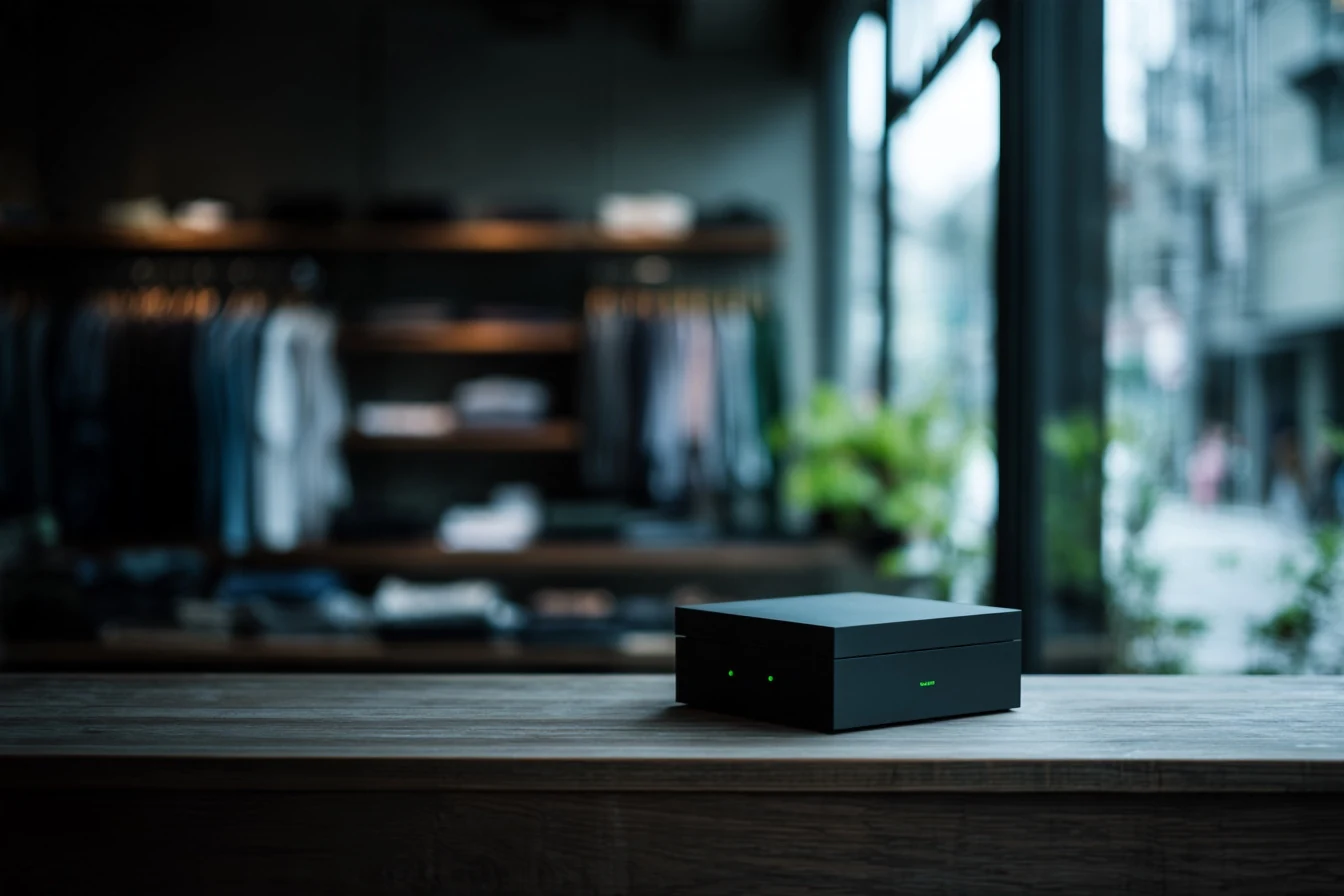
- A Jetson
- A computer that fits in your hand, made by NVIDIA to run AI where the data is, instead of in someone else’s cloud. One would sit on a shelf in each store’s back room.
- A morning note
- Each store manager would get a short note from their store’s computer before opening: what moved yesterday, what stalled, and the floor redrawn for what’s actually in the stockroom, with new pairings where sizes have broken and what should go to the window. The manager decides what to do.
- A design review
- Every quarter, we’d read what the fleet found and ship the next version of the store: a fixture moved, a district changed, a rule for the next opening.
2 · What sits in each store
What a Jetson is, in plain words.
Study image
A Jetson is a small computer made by NVIDIA for running AI where the data is: in a robot, a drone, a factory or a shop, instead of in someone else’s cloud. It fits in your hand and sits on a shelf. It runs an open source AI model, not one of the big frontier models in the cloud. It is smaller, it belongs to you, and what it reads never leaves the store.
In each store it would read only what the store already records: how many people came through the door and when, and, in stores that read their tags, what went into the fitting room and came back. The day’s sales come from head office, so it never sits on the card network. Each night it learns that store’s patterns and writes its manager a note. Nothing it reads is sent on.
It is one careful worker, not a crowd, and one is enough: a store makes a day of data, and the computer has all night to read it.
What travels to the mothership is what it found, not what it saw: this rail moves on Saturdays, this fitting room waits too long at five, this district sells more when the window changes. Those findings are about the store, never a person: counts and sales by the hour, with no shopper in them. It is built so that no one shopper can be picked out.
3 · The fleet
A store is an interface you can walk into. Give each one an AI of its own and every store becomes a shop and a sensor, with one memory between them.
Swipe sideways for the whole drawing
Fig. 1. The fleet. Each store’s computer (1) learns that store alone; only what it found travels up (2) to the mothership (3), which passes the whole fleet’s findings back down (4), to every store and to the next one before it opens.

Study image
4 · Every opening starts from the fleet
A rollout usually copies the first store from drawings and cuts what it can’t explain. Here, every opening starts from what the whole fleet found, and the studio ships the next version of the store each quarter. Where the money shows: in the openings. A new store that starts from what the fleet found would need fewer fixes after it opens, and the tills would show whether it did.
Swipe sideways for the whole drawing
Fig. 2. The aim, drawn. In the usual rollout each store drifts a little further from the best one. With a fleet that keeps what each store finds, every new store starts from what the others found. A drawing of the aim, not a result.
5 · We build our own first
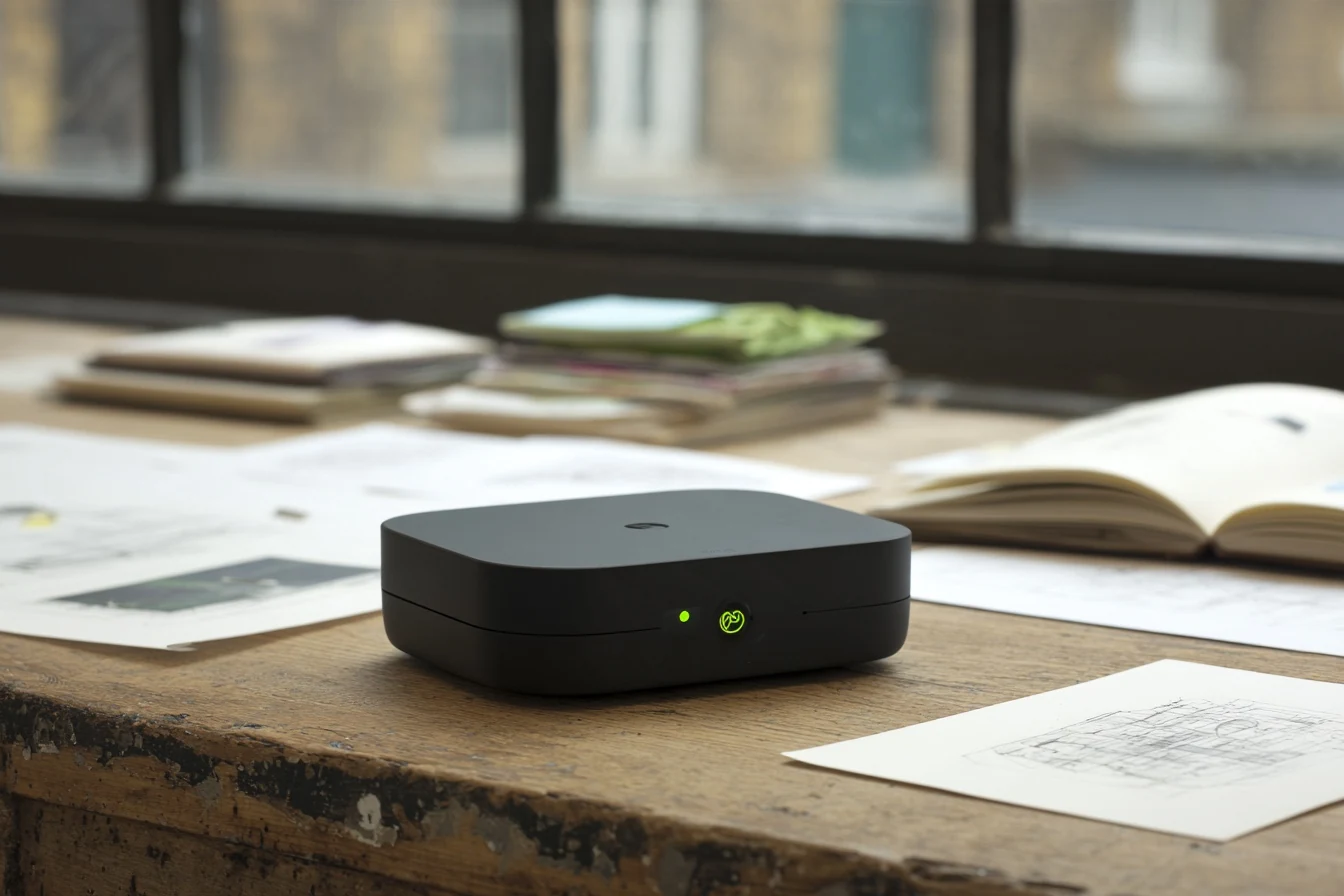
We are starting the studio’s own brain, on a Jetson of our own. It is not part of anyone’s fleet. It is how we show we can build one.
Study image
It will hold the studio’s archive: the stores, drawings, research and notes of James’s 27 years, on our own hardware, not uploaded to anyone’s cloud, so nothing we have found is lost between projects.
It is already at work. It reads a photograph of a store in about half a minute: some 2,500 a day, more than 15,000 in a week, on a computer the size of a book.
Yours would be yours, and it may look nothing like ours. We’d work it out with your team: what your stores should count, what they already record, and whether you need a computer in every store, in a few, or in none. Whatever you build, your data stays with you.
6 · Why it should work
Every store opens on a plan from head office, and by the first Saturday the plan is out of date: sizes break and the best pairings sell through. A plan drawn once for the whole fleet can’t keep up; one redrawn every night for each store can. None of the parts is new. Phones have trained shared models without sharing their data since 2017, and factories have known for ninety years that the hundredth plane takes less work than the first. Stores already use computers like these to watch the shelves and the checkouts. We’d point them at the design: what each store finds goes into the next one we draw. Online, the screen is turning into an assistant that shops for people. The store is the one interface it can’t walk into for them, so the store should learn as fast as the screen does.
“The most profound technologies are those that disappear.”
Mark Weiser, The Computer for the 21st Century, Scientific American, September 1991, page 94
Swipe sideways for the whole drawing
- PrecedentThe keyboard, 2017Google trained the suggestions in its phone keyboard across many phones while what people typed stayed on each phone. Only what the phones found travelled.
- HistoryThe learning curve, 1936T. P. Wright showed that each time aircraft output doubled, the labour per plane fell by a steady share: the plant got better at what it had already built.
- The mindThe computer that disappears, 1991Mark Weiser argued that the best technology disappears: people use it without noticing it. A computer on a back shelf that nobody on the floor ever has to think about.
- MetaphorThe starterA baker keeps a sourdough starter alive, feeds it every day and passes some on. Every loaf carries what the culture has become.
The idea
A rollout with a nervous system.
An open source AI in every store, a mothership that shares what each one found, and a studio that ships the next version.
Fig. 3. Where the idea comes from: a keyboard, an aircraft plant, a computer nobody notices and a baker’s starter.
| What the research shows | What it means | Our principle | The rule | In MOTHERSHIP |
|---|---|---|---|---|
| In 2017 Google began testing a way to train one shared model across many phones while the data stayed on each phone, starting with its Gboard keyboard (McMahan and Ramage, Google, 2017). | A fleet can share what it found without sharing what it saw. | Keep the raw data where it was made. | Only findings leave the store. | The mothership. |
| In 1936, T. P. Wright found that each time aircraft output doubled, the average labour per plane fell by a steady share (Wright, 1936). | Things made many times can get better with every one, if what was found is kept. | Keep what every store found. | Every opening starts from the fleet. | The next store opens knowing. |
| Open a store, and online sales around it go up; close it, and they drop (ICSC, The Halo Effect III, 2023). | A store’s effect reaches past its walls. | Count the store by everything it causes. | The fleet reads the store and the site together. | The morning note. |
7 · How we’d prove it
Nothing here has been built or measured. If a brand wanted it, we’d find out if it works in three weeks, in two stores, before anyone rolls it out.
- Week one: one store
- We’d put one open source AI in one store, reading only what the doors and the tills already record. The manager gets a note every morning. Nothing leaves the building.
- Week two: a second store
- A second computer in a second store. The mothership compares what the two found, and sends each a note on what the other one found.
- Week three: one change
- Store two would make one change because of what store one found. Before we start, we’d agree with you what the tills have to show for it to be worth rolling out. Then we’d tell you if it is.
Want it for your stores? We’d start with the same three weeks, in two of your stores. Like the Roadmap, it ends in a decision.
Contact